iconLog In  |  Register

Cocktails 101: The Margarita

Last year, The Hold Steady passed through Champaign-Urbana, and I didn’t go to see them.  I fell out with them over Boys and Girls in America, and, unfortunately, Stay Positive, the album they were touring in support of, wasn’t much of an improvement.  I miss The Hold Steady of ...Almost Killed Me and Separation Sunday; I miss the stories about deadbeat dealers, barflies, and Christian girls who maybe died and maybe actually came back to life.  Which is a long way of leading up to talking about one of their least known and best songs from their relatively early days, a number called “212-Margarita”, inspired, according to Craig Finn, their lead singer and creative spirit, by lawyers’ ads in the New York subway promising a big pay-off for, well, for someone.  In it, Finn announces that he “like[s] the salt on the rims of the glasses, because that makes us thirsty, and when we drink we all fall in love.“

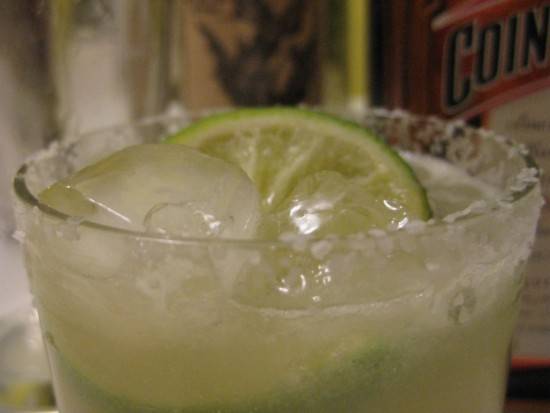
That line gets to something very true about The Margarita (and, no, I promise I’m not about to start philosophizing).  The Margarita, as a drink, is as roundly abused and debased as any I’ve mentioned in this column before.  It’s made with sweet and sour mix, with cheap tequila, without triple sec, and, surprisingly, it doesn’t matter.  It’s still delicious.  I think the salt’s the trick.  The sweet and salty combination, with the weird vegetable spiciness of the tequila behind it, is one of the best things I’ve ever drunk.  Not enough drinks pull a salt rim, and it comes as such a surprise that you’ve got no defenses.  So, rather than spend a lot of time going over the inadequacies of most Margaritas you’ll find in the C-U area (of which there are many, although Radio Maria makes nice ones), I’m just going to tell you how to make a good one yourself, and let you decide if it’s worth the effort (I think it is).
To understand the Margarita’s history, it’s important to realize that it’s not a modern cocktail.  It’s a member of the Daisy family of drinks, which consist of a base liquor, orange liqueur, and lemon juice.  This family also includes the Sidecar, made of brandy, Cointreau, and lemon juice, and the White Lady, which is the same as a Sidecar but with gin.  In fact, “margarita” in Spanish means “daisy”.  Hmm.  It’s easy to imagine some late 19th or early 20th century cocktail aficionado running out of brandy and lemons near the southern border, picking up some climatically appropriate tequila and limes, and walking away into greatness.  Tequila, which is often strangely salty on its own, must have been the inspiration for the rim.  Wherever it came from, it’s a brilliant combination.

In order to make a really fantastic Margarita, you need to make sure you have decent tequila, decent orange liqueur, and fresh limes.  Decent tequila means 100% blue agave —- if it doesn’t say that on the bottle, it’s likely that it’s up to 49% sugar-derived alcohol, meaning that it’ll taste less like agave and more like crap (it also will be cheap, and probably give you a hell of a hangover).  100% blue agave tequila comes in three ages: blanco, reposado, and añejo.  Blanco is not aged in oak, although it may be rested in steel containers for some months, which will help soften its raw edge, but leave it uncolored.  Reposado is aged in wood for three months to a year, and comes with some vanilla and spice overtones and a light straw color.  Añejo is aged for one to three years in oak, and will usually be whiskey-colored, with much stronger caramel, maple, and vanilla overtones, although the best añejos retain some of the spicy, vegetal characteristics of the raw tequila.  I personally enjoy using reposados for Margaritas, but many purists argue that you should only use blanco tequilas.  In terms of brands, I’ve had great success with using Sauza Hornitos (their premium label) as a mixer; it’s sweeter and smoother than many tequilas, and, with its peachy nose, a great introduction to the variety of flavors that can be found in this under-appreciated spirit.

Orange liqueurs, in general, are made by infusing either a neutral spirit (in the case of triple secs and curaçaos) or a wood-aged spirits (like rum or brandy — think Grand Marnier) with orange zest and other aromatics.  I recommend that, for most mixing purposes, and especially for Margaritas, you use a triple sec like Cointreau.  It brings a pure, bright orange flavor without adding any muddying, wood-based characteristics.  But Grand Marnier and other wood-influenced orange liqueurs are often delicious in their own right or as ingredients in the right cocktail.

I’ve covered squeezing fresh citrus juice before, and I maintain that it is essential for producing exemplary cocktails in general and Margaritas in particular.

The Margarita

  • 1 1/2 oz tequila
  • 1 oz orange liqueur
  • 1/2 oz lime juice
  • Kosher (coarse) salt

Pour several tablespoons of salt onto a small plate.  Cut a small wedge of lime, rub the lip of a short glass with the lime, and twirl the glass’ lip through the salt in order to create a salt rim.  Fill the salt-rimmed glass with ice and set aside.  In a cocktail shaker, combine all other ingredients, shake well with ice, and strain into your prepared glass.  Garnish with a small lime wedge if that gives you a thrill.


Margaritas are obviously best on a really hot summer afternoon, but their surprising complexity makes them an appropriate drink for any season.  They’re an excellent reminder that, somewhere in the world, it’s warm and it’s cocktail hour.


3 comments

username

Frederic

#1

The Daisy family isn’t as simple as just orange liqueur.  Harry Johnson’s (one of the earliest recipes, 1882) has yellow Chartreuse, Jerry Thomas’ (1887) has orgeat, and newer ones often have grenadine or raspberry syrup.
http://cocktailvirgin.blogspot.com/

Rob McColley avatar featured_post

Rob McColley

#2

Marketing and conspicuous (i.e. nervous, wanting to fit in) consumption have killed off good liqueurs and replaced them with sugary, non-alcoholic substitutes.
 
In the case of triple-sec and various Schnapps and Snaps, it’s reduced the art of boozecraft to near soft-drink proportions. The average DeKuyper crap is 15% alcohol. 
 
The remaining content may be high fructose corn syrup and water. They are not obliged to tell us. 
 
And don’t get me started about “Pucker.“
 
Good inexpensive Triple-Sec (DeBouchette, Hiram Walker) is nearly indistinguishable from the original Cointreau. Grand Marnier is simply excellent.

Ryan Neaveill avatar

Ryan Neaveill

#3

Hey, thanks for this info. I’ve never been able to make a good Margarita and it’s always confounded me, so I’m eager to try your suggestions. I think my problems have been mainly not using the fresh lime juice (usually just from laziness) and the tequila itself (usually used jose cuervo). I’ll try yours tomorrow—Cinco de Febrero!


Add A Comment

A note about our commenting policy.


Comment
  1.  captcha arrow

Most Recent Food Comments

emma reaux avatar

I joined on 09-09-09 after living here over a year, and having to listen to my dad tell me how his best friend is, like, #27 or something crazy like that, and how said friend never lived further than 50 feet from the Illini Inn while going…

{username}

Looks like you are also all members of the killer sideburns club.

Joel Gillespie avatar

@Annie: Yeah, my bad. That was the best part! Drinking + memory exercises = fun @Rob: According to Ask the English Teacher, “My dictionary says ‘drunk’ is an archaic past tense of ‘drink.‘“ We’re all about the new grammar around here.

Rob McColley avatar

“more beer is drank”   Awesome. Way to go “editors.“

Annie Weisner avatar

You left out the best part—you have to REMEMBER your number after the beer chugging!     Yeah, I’m a member.

{username}

Great article, man. Like you, I didn’t really know Daniel all that well, but I felt the impact of his death. I too was inspired by him and it pleases me to see that he continues to live on in the spirit of the community.

Justine Fein-Bursoni avatar

Thanks you guys…I love living in a community that can connect, share, and create through food. It’s inspiring…

{username}

<div> A beautiful recap of the evening and thank you for sharing why you find what the Fund is doing is inspiring. I haven’t been able to write too much about my feelings about the community’s loss of Dan yet either, but Dan has also inspired me…

{username}

Seth and Justine, thanks so much!  Through your writing and your photos, everyone can get at least a taste of what was served up Sunday night.  Dan would very much have liked that! As you say, our community is very much “fertile ground,“ and Dan had such…

{username}

That is perhaps the best article you have ever written… a love letter to Champaign-Urbana and the people who call it home.

Most Recent Comments

{username}

Illinois has simply had no luck at all in these Mizzou games. None. I think maybe we’re do for a couple of bounces to go our way. If we get one or two (or sever or eight) breaks, I think it’s a win. 

Dan Schreiber avatar

Jason, Savoy could easily join the CPL tax district, which is probably closer to most Savoy residents than the Tolono library is.  But my impression is that Savoy residents as a whole don’t want to pay the cost of the CPL (Tolono’s library taxes are cheaper), even…

{username}

Sorry, but I am lagging behind on updates to the map. Also, some construction projects were delayed from their original start date. On a more positive note, I am putting together a map of haunted houses in Central Illinois. I have a few plotted already, and I…

{username}

I’ve never gotten the privilege of all the services CPL cardholders get.  I just want to be able to go out of my way to drive to the CPL to check out books, pay fines, maybe buy some coffee, and enjoy the library.  None of those activities…

{username}

These days, there is more to using a library than checking out books. At one time, paying into the Lincoln Trails system probably would cover the expenses incurred by other libraries in the system. Now, with Internet, videos, coffee shops, wireless Internet hubs, etc., I suspect the…

{username}

(speaking as a Savoy resident)  By paying taxes to support a member of the LTLS, we are paying our “fair share” to use any LTLS library—Tolono, Champaign, Urbana, etc.  This is how library systems work.  The 6% of CPL’s circulation represented by Tolono users is NOT significant…

Rob McColley avatar

I read Timbo’s argument. I think the key word is “speculating.“

{username}

I would be interested to hear more about the “word on the street”—how are individual hauling companies fulfilling their promise to recycle?

{username}

Timbo makes a smart, sound argument. Reread it.

emma reaux avatar

I joined on 09-09-09 after living here over a year, and having to listen to my dad tell me how his best friend is, like, #27 or something crazy like that, and how said friend never lived further than 50 feet from the Illini Inn while going…

Dan Schreiber avatar

And, I might add, no one is being prevented from using the Champaign library. They are just being asked to pay their fair share if they are going to use it as their primary library.

Dan Schreiber avatar

The equation is pretty simple here. If you want social services, then pay the taxes required to run those social services. These things only work if everyone puts in their fair share. As a heavy user of the Champaign Library, I say bravo to this new policy.

Timbo avatar

Curtis Orchard is always good for an hour or three, especially if you have rugrats.

Timbo avatar

What is the increased marginal cost of serving a resident of Savoy or Mahomet? I suspect negligible. What is the increased revenue to be realized by this new policy? I suspect very little. Aside from these financial aspects, what are the most probable results from this new…

{username}

Looks like you are also all members of the killer sideburns club.

{username}

Thanks for the article, Ben.  I was not familiar with this band until now and even though I won’t be able to attend the show on Friday they are now on my radar.  A *good* jam band is hard to find, and these folks appear to fill…

{username}

Nice article, love the Dead quote in the beginning. If they can get down here to Central FL I’ll definitely be heading out to the show. Some of my friends have finally stopped wincing when I say “jam band.“ I’ve now tried my best at more descriptive…

Joel Gillespie avatar

@Annie: Yeah, my bad. That was the best part! Drinking + memory exercises = fun @Rob: According to Ask the English Teacher, “My dictionary says ‘drunk’ is an archaic past tense of ‘drink.‘“ We’re all about the new grammar around here.

Tracy Nectoux avatar

Katie, have the residents of Savoy and Tolono thought about having their taxes raised a little to help their public library expand? That’s a possibility for them. And then everybody wins.

Ben Valocchi avatar

good call on that Herring recording, Josh. Love that version of Exit Music….here’s a clip of the Cinco de Mayo show (from about six months prior). As I recall, this Shakedown went on for roughly a half hour, while getting into the Trampled Underfoot jam in the…

Log In


Auto-login on future visits

Forgot your password?