


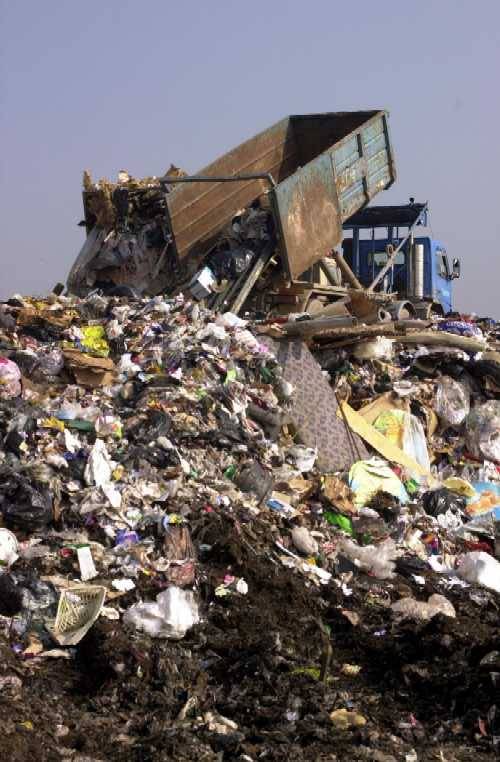
It’s not true what they say about garbage. You know, “out of sight, out of mind.” People actually do want to talk about garbage. In fact, the topic of garbage arouses great passion, perhaps precisely because no one is ever given the chance to talk about it. It’s a great hidden shame, our garbage, overflowing in obscenely huge mountains out on the ragged edges of our cities and towns, or dumped in our oceans at a rate six times greater than fish taken out for our consumption.
“Everyone should visit a landfill at least once in their lives,” implores Pete (not his real name), an ex-garbage hauler who spent five years in the business, from a bar stool in downtown Champaign. “You’d be absolutely amazed at the enormity of it all. And there are people living next door, you know, poor people. These places are always in poor areas. But nobody cares. All they want is for the garbage to be gone. As long as the bill isn’t too expensive. But it’s not gone.” He shifts in his seat, softens his voice. “There is no market for recycled glass, you know, never is. All that glass ends up in a landfill. Yes, there are regulations, but mainly about truck weight and stuff like that. You are supposed to treat medical waste differently. The hospital has to pay extra for that. But it all ends up in the same landfill with your kitty litter and old tomatoes.”
Somehow, we suspect this already. The garbage business has a dirty reputation: fierce competition, mega corporations and haulers that profit from our negligence, kickback schemes, and, in select locations, mafia involvement. Less than twenty years ago, the Ventura County, CA District Attorney predictably reported that national powerhouse Waste Management Inc.”engaged in practices designed to gain undue influence over government officials…and manipulate local government for its own business ends.” How much things have changed, and where, is pure speculation, in spite of government efforts to clean up the industry. One thing is for sure: bypassing weak antitrust laws, Allied Waste and Republic Services, the nation’s second- and third-largest waste-haulers, have now merged in a deal worth more than $4 billion. In 2009, those merged companies along with Waste Management — top of the heap in the garbage business — controlled more than two-thirds of the landfills in the United States and the majority of the residential and commercial waste industry.
Studies show that since 2006, these three companies have steadily raised base prices across the board, sometimes hiking rates more than 50 percent over current prices. Here in East Central Illinois, Danville’s Lou Mervis, former CEO and acting President of the Board of Mervis Industries, one of the nation’s largest recycling companies, has bestowed contributions to almost every local Republican’s (and a few Democrats as well) campaign chests for the past few decades, in addition to his extensive civic and charity contributions. No, you don’t have to be crooked to survive in the garbage business. But you have to be tough, tough as nails. And you have to play the game.
 All this is precisely what haunts us and what fuels our anxiety and mistrust when it comes to our garbage. We really want to do the right thing, and we want others — haulers, recyclers and landfill operators — to do the right thing as well. It is just that nobody is actively regulating or overseeing the industry, and never really has. We send off our recycling with our fingers crossed that it might actually get somewhere close to a recycling plant. City, county and state governments mandate recycling in many instances, but offer no oversight or comprehensive enforcement. In a phone interview Champaign City Councilwoman Deb Feinen notes, “It is interesting that over the course of one term I’ve seen a big switch and people really want to see a recycling program in Champaign, and they seem willing to pay for it.” That is, a recycling program operated and overseen by the city, not by the confusing myriad of waste hauling companies jockeying for our business in Champaign County.
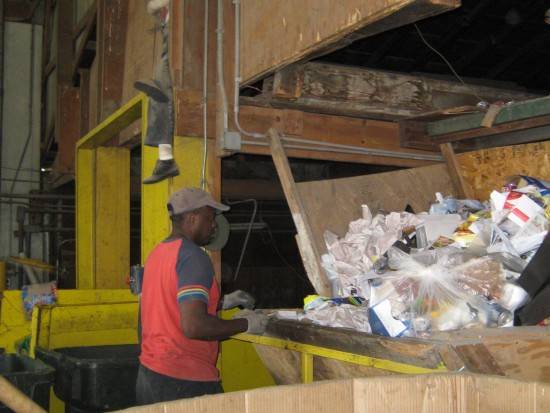
That public sentiment has turned in favor of a government-implemented recycling program here is no surprise, really. Recycling messages surround us in popular media. Kids learn about recycling at school. But here in Champaign, recycling programs are confusing and unenforceable, partly because they vary with each individual hauler. And some companies don’t pick up at all, although city ordinance mandates curbside service within city limits. Rumors abound about trucks turning the corner and dumping recycle bins in with household trash. Haulers themselves accuse each other of not recycling: “Oh, absolutely they don’t recycle. I’ve seen their trucks full of recyclables sneaking into the Danville landfill… on a Sunday afternoon (when the landfill is officially closed)!” one owner attests.
In the meantime, independent hauling companies such as ABC and Illini Recycling, realizing that there is a market for “honest” recycling practices, are anxious to spread the word about their local facilities, where, they say, recycling is done right. Even City Councilman Tom Bruno, a long-time champion of free market solutions, has now changed his position and supports a city-initiated program, like the kind sister city Urbana has had for over ten years.
It seems like everyone wants to know what is happening to our garbage: where it goes, how much is indeed getting recycled, who is lining their pockets. So, in the end, it isn’t merely recycling services that we want, it’s the control over those services we desire. Perhaps city councilman Michael LaDue will finally get the solid waste audit he’s been after all these years, something that might reveal the true state of the waste management mess that exists right now in Champaign County.
A CHECKERED PAST
But it wasn’t always this way. At once time in the early 1990’s, Champaign County was closing in on a deal that would have allowed a more streamlined, and ultimately more accountable, system. The deal was a tree-hugger’s dream. All the governmental entities in Champaign County would cooperate in order to operate their very own new landfill (to replace the maxed out Urbana landfill) and transfer/recycling station. No more sending over-packed trucks hours away to dump their loads. No more complaints about noisy and garbage-truck-congested side streets at 3 a.m. Shorter hours, less wear and tear on trucks and roads, less gas consumption and most importantly, more local control over waste removal and recycling practices. It wouldn’t be just Urbana that would have the first, and best-in-the-state, curbside recycling program anymore. No, the entire county would become a prototype for green waste management for the state, and perhaps even for the entire nation. This new agency was called the Intergovernmental Solid Waste Disposal Association. And in just a few short years, it failed. Miserably.
What actually happened depends on whom you ask. Some point their fingers at large, politically well connected, out-of-county landfill operators such as Lou Mervis and Roy Coulter, guys who had a stake in maintaining the status quo. As one city official explained, “Those guys bankrolled expenses to counter everything government was trying to do!” Others point their fingers at county board members who were a bit too friendly with potential landfill and transfer station operators, operators that, they say, are now serving prison time for their political maneuvers.
Moreover, “they were going to over-inflate prices and pass this on to residents. And no one was asking questions.” says Cindy Eaglan of Illini Recycling, a 59-year veteran of the business (her dad started in the business when she was 2). In the end, she explains, “ISWDA had good intentions, but didn’t know much about the hauling business, how things really work.” Some blame infighting among the liberals that were spearheading the project.
Others point to tense relations with farmers and misguided property right negotiations near Homer, where the new landfill was slated to be located. “They wanted to build right on top of an aquifer,” maintains Steve Smith of ABC. “You can’t do that.” The final blow just might have been a lawsuit filed in 1992 by Smith on behalf of 15 local garbage haulers against the ISWDA in order to block the building of a countywide waste transfer station. In this case, the plaintiffs argued that a Request For Proposals (RFP) and the subsequent competitive bidding process was unfairly biased in favor of XL Corporation, the company ISWDA was negotiating with to operate the station. In a dog-eat-dog world, independent waste haulers were feeling the squeeze from the ISWDA. If only one company or hauler gets contracted, especially a company from far a field, what would happen to everyone else? In the end, the plaintiffs won the case, the City of Champaign withdrew from the organization and the county was left without a unified waste management agency, and, effectively, without a comprehensive recycling program. A situation that continues to this day.
In the wake of the failure of the ISWDA, municipalities in Champaign County were left on their own to cobble together piecemeal recycling and waste removal programs. Many smaller, cash-strapped towns in the county simply gave up entirely on the idea of recycling, and still don’t offer services today. The University of Illinois, most likely disgruntled at the lack of progress towards green initiatives in the county, took it upon themselves to build their own recycling facility. The City of Champaign passed ordinances regarding recycling services, but offered scant follow-up, oversight or citizen education. They simply left it up to the dozens of private haulers to sort the recycling situation out themselves.
Currently, only about a quarter of the 46 original recommendations made by the ISWDA concerning recycling, reuse, yard-waste, commercial waste, etc. have actually been enacted. Officially, these recommendations still make up Champaign County’s Solid Waste Management Plan re-adopted in 2007 (resolution 6146), but without the money or intergovernmental cooperation and jurisdiction, most of these recommendations simply gather dust. And C. Pius Weibel, current chair of the Champaign County Board, doesn’t see things changing soon for county residents without services: “I don’t see the county doing anything right away without money. We’ll have to wait and see what happens with other municipalities.”
A BETTER FUTURE?
But if the City of Champaign has its way, things may indeed soon change, at least within city limits. Elizabeth Hannan, Administrative Services Manager at the Champaign Public Works Department is currently working with city council on putting together a comprehensive recycling program. In April, the city hired a recycling coordinator, and most recently, on July 20th, approved a contract with Allied Waste to provide recycling services for larger apartment complexes and buildings with more than 5 units. “This is just the first step,” says Hannan. The next steps, according to city officials like Hannan and City Councilwoman Deb Feinen, would be to hopefully revisit the current single-family and commercial recycling programs, and make improvements that would streamline the process by contracting services with a limited number of haulers. Again, a competitive bidding process would be used to determine the contracts.
This sounds promising, of course, for city residents, but if there is anything to be learned from the past, it’s that dealing with the waste hauling businesses isn’t a walk in the park. You can’t enter into the arena unprepared, naïve, or filled with lofty ideals. You have to know what you’re doing. You have to know the history of waste management in the area. You have to know the players, their names, their kids’ names, whether or not they have a scale at their facility, how many trucks they’re running, the muddled history of their allegiances. You have to know the real numbers, make the rounds in order to know the real numbers. You have to know where the recycling plants are, and which ones are fixing their numbers. You have to research if the EPA indeed gets funds through taxes charged at the landfill gates. You have to know that there isn’t a chance in hell that there is a market, or will be anytime soon, for glass recyclables. And you have to know the scams. “Everyone in the business has a scam, you know,” a waste company owner tells me, smiling.
But it doesn’t stop there. You have to know, because it happened in 1992, that as soon as a contractor is chosen, especially a non-local franchise, there will be palpable fear that the franchise will drive the hauling costs so high, small businesses won’t be able to compete. And perhaps for good reason. Studies conducted by The Center for Competitive Waste Industry, a not-for-profit advocacy group based in Madison, Wis., demonstrate this trend nationwide, a trend that has made the center allies with environmental groups from the Sierra Club to grassroots recycling groups. Why? “Well, recycling is expensive. It has to be hand-sorted to do it correctly,” says Cindy Eaglen, of Illini Recycling. There aren’t any recyling plants near Champaign-Urbana, and all those transport costs. “Big companies just want to fill their hole and make money,” says Steve Smith over at ABC, “They don’t care about recycling, there is a much bigger profit in just dumping it.” Indeed, many large companies own interests in not only the hauling trucks but also transfer and recycling stations, and even the landfills themselves. Besides, says Smith, contracting with large franchises takes jobs away from the community.
Did the City of Champaign consider this last month when awarding their recycling contract negotiations to industry giant Allied Waste, a company based in Arizona, and whose closest facility is outside of Indianapolis? “Usually, there is a built-in preference for local businesses, and council takes this into account. But what makes something local is difficult to say much of the time,” councilwoman Feinen offers. Over at Public Works, Hannan explains that Allied had the best price and that city officials visited their facilities and were satisfied. But she wasn’t sure if local job creation was considered. Councilman Tom Bruno points out that only one of the responding companies met the required qualifications. “Staff then analyzes the proposals that met the qualifications, in this case just Allied, and makes a recommendation to the city council to either accept it or to start over.” But what if local businesses simply can’t meet the requirements to submit proposals? What if the very bidding process itself is biased in favor of large corporations? If you ask around, nothing good has come from contracting services from these out-of-state franchises. Allied Waste, who currently runs the only transfer station in the county, at one time agreed to also build an adjacent recycling center as part of the deal. And where is that recycling center today?
In the end, for independent hauler Cindy Eaglan, it is all about community and accountability. “I’ve lived here all my life. I can look people in the face. There is no single person from Allied, Peoria Disposal or Republic that has ever lived in this community. All they do is take out of the community.” And although she is pleased, very pleased, that the city is taking initiative to create a workable recycling plan, she is worried that lessons from the past will be forgotten and it won’t be done correctly. She advocates more government oversight and the creation of a framework for accountability on all levels, national, state and local. And this from the Vice Chair of the Champaign Tea Party.
Once thing is for certain: garbage in Champaign County is a messy business. Buyouts, mergers and feuds between haulers are commonplace. Enemies become bedfellows overnight. Everyone has something to hide. Few people want their real names used in stories like this. And yet, people want to talk, want to come clean. If only someone would listen. “The government has ignored this issue for too long, on all the levels: federal, state and county,” says Eaglan. “The paradox is that everyone wants to recycle. But you have got to have help.”
———
This is a follow-up article to Brenda’s piece “Is your recycling being dumped in a landfill?” which was published in November 2009. This piece was crowd-funded by Smile Politely readers through a collaboration with Spot.us. You can read this story on Spot.us and read the list of contributors here. Thanks to Brenda, Spot.us, and our generous readers. Let us know if you have an idea for an investigative piece (that you or someone else could report on) that you’d like to see us pursue.